At your desk
By afternoon your shoulders are tight, your back is tired and concentration takes more effort.
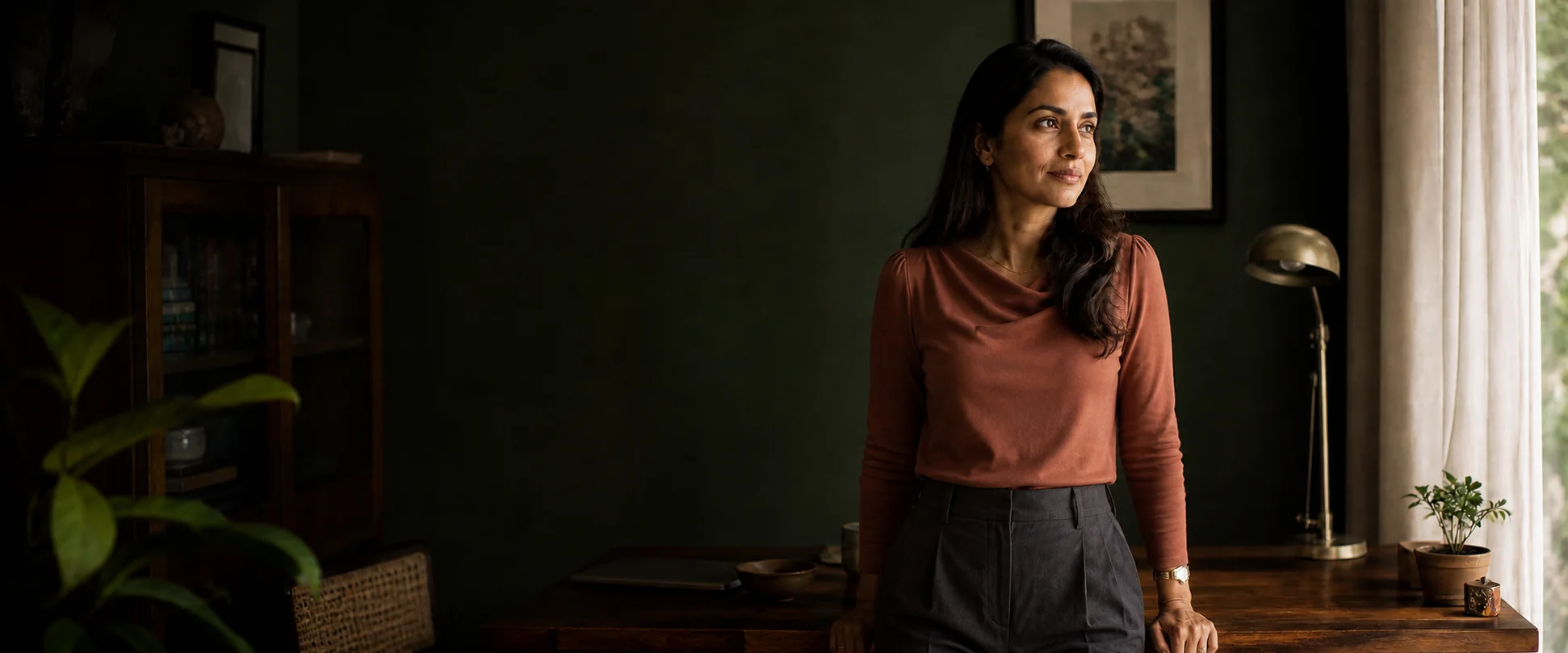
A personalised 12-week programme for women navigating changes in energy, sleep, stress, strength, menstrual health and midlife — while work and everyday responsibilities continue.
Live 1:1 online with Soma Mukherjee
You may still be meeting deadlines, leading calls, caring for family and getting through long workdays. But sleep no longer restores you in the same way. Energy dips without warning. Periods may be more difficult or unpredictable, and exercise that once felt good can now leave you exhausted.
Sometimes it starts with anxiety. Sometimes with fatigue. Sometimes with a period that suddenly feels different. Often, it is more than one thing.
Perhaps you are managing PCOS or a medically managed thyroid condition but still feel tired. Perhaps perimenopause has started quietly — through changing sleep, mood, periods or recovery — earlier than you expected. Women’s health rarely arrives as one neat problem. This programme helps Soma understand the combination and build your practice around it.
The signs are often ordinary enough to ignore, especially when work and family still expect you to carry on as usual.
“I feel more anxious than I used to, and I cannot quite explain why.”
“My thyroid is treated, but I am still exhausted.”
“My periods have suddenly become different.”
“Could this be perimenopause already?”
The programme does not begin by deciding which label fits you. It begins by understanding what has changed.
By afternoon your shoulders are tight, your back is tired and concentration takes more effort.
You are expected to sound composed even when poor sleep, cramps, a hot flush, anxiety or exhaustion has already taken part of your attention.
There is still family, caregiving, messages and tomorrow’s preparation. The working day ends; the load often does not.
You are tired enough to want sleep but not settled enough to reach it easily.
Sleep changes energy. Stress changes recovery. Pain changes movement. Long periods of sitting affect mobility and capacity. Hormonal transitions may arrive alongside changes in mood, temperature, strength or concentration. That is why the programme does not begin by putting you into a category.
What is affecting your life most right now?
For anxiety, emotional overload, irritability, low mood or simply feeling unlike yourself. Work pressure, caregiving, poor sleep and physical changes can often overlap.
For women navigating thyroid conditions, PCOD/PCOS, changing cycles, perimenopause or menopause. The programme supports movement, strength and recovery alongside appropriate medical care.
For difficulty switching off, broken sleep, waking unrefreshed or feeling that your body never quite catches up. Practices are adapted around your workday, energy and changing needs.
For concerns around weight gain, overweight, obesity, insulin resistance or changing metabolism. The focus is sustainable movement, strength and healthier routines—not crash diets or appearance-led weight loss.
For painful, heavier, irregular or changing periods that interfere with work, exercise or everyday comfort. Practice is adapted to how you actually feel rather than rigid cycle-based rules.
For neck, back, shoulder or hip stiffness from long hours of sitting, screens and repetitive work. Small movement changes can be integrated into the working day.
For women who want to regain strength, balance, stamina and confidence in everyday movement. Progress starts from your current capacity rather than a predetermined fitness level.
You may recognise yourself in several of these. Personalisation begins with the combination.
Map your energy, sleep, movement, workday and health context. Begin with a safe, useful starting point.
Develop sustainable movement, mobility, recovery and appropriate strength before adding complexity.
Build capacity and adapt around symptoms, energy and changing priorities.
Test full practices and shorter alternatives against busy weeks, travel, periods and family demands.
Review what changed and leave with a personal framework you understand well enough to keep using.
Mobility matters. Yoga can be valuable. But women also need strength. Where appropriate, the programme includes progressive strength alongside movement and recovery. The aim is not to train harder. It is to become more capable.
Breathing, quieter movement and recovery practices are used when they suit the person and the moment. They support settling and recovery; they are not presented as treatment for hormonal or medical conditions.
Women’s Health & Vitality does not diagnose or treat PCOS, thyroid conditions, anxiety disorders, depression, endometriosis, adenomyosis, ovarian cysts, osteopenia, osteoporosis, perimenopause or menopause-related symptoms. It works with movement, strength, mobility, recovery, sleep habits, everyday stress and sustainable routine alongside appropriate care.
Movement consistency, gradual strength, workday mobility and recovery.
Appropriate strength, mobility, sleep habits and adaptation around hormonal transition.
Progressive strength, balance and mobility alongside medical guidance.
For nearly three decades, Soma Mukherjee has worked with adults and professionals whose health does not exist separately from their jobs. She brings together movement, yoga, breathwork, strength, reflection and practical habit-building support — beginning with the person rather than prescribing a standard routine.
Meet Soma →Soma confirms your start date and explains how the programme will run.
You complete a private health and lifestyle intake.
You establish what is affecting you most and set realistic priorities.
The sessions evolve according to your response rather than a fixed template.
You leave with an ongoing personal practice framework.
Changes in periods, sleep, mood, temperature or energy can make you wonder whether a hormonal transition is beginning earlier than expected. The programme does not diagnose perimenopause or menopause. Soma can adapt movement, strength and recovery around what you experience, while diagnosis and concerns about unusually early menopause belong with a gynaecologist or other appropriate medical professional.
Movement and recovery can be adapted around difficult days, but the programme does not diagnose or treat the cause of severe pain. Symptoms that are severe, worsening or disruptive should be medically assessed.
No. PCOS requires appropriate medical care. The programme can complement that care through sustainable movement, appropriate strength and recovery support.
Fatigue can have many causes. When a thyroid condition is medically managed, Soma can adapt movement, gradual strength and recovery around your present energy. Persistent or unexplained fatigue should still be reviewed by your treating physician.
You will have fuller practices for days that allow them and shorter, meaningful practices for days that do not.
No. It may include yoga, progressive strength, mobility, breath, recovery, reflection and practical habit-building support.
Weight loss is not the primary purpose. The focus is strength, capacity, movement, recovery and sustainable health behaviours.
Possibly, depending on symptoms and medical guidance. Significant pelvic symptoms remain with your clinician or pelvic-health professional.
Tell Soma during intake. Strength and movement may be valuable, but the programme must respect your diagnosis and clinical guidance.
Anxiety, low mood and emotional depletion can overlap with poor sleep, workload, caregiving and hormonal transition, but the programme does not determine the cause or treat a clinical disorder. Movement, routine, recovery and reflection may support everyday wellbeing; persistent sadness, loss of motivation, severe anxiety or symptoms affecting daily life require qualified mental-health or medical care.
The core programme is not designed for pregnancy or early-postpartum rehabilitation. Soma may ask for medical or pelvic-health guidance first.
You leave with a personal framework for continuing what proved useful. Lower-frequency support may be available where appropriate.
You do not need to decide whether the answer is stress, sleep, hormones or strength before you speak with Soma. That is what the first conversation is for.
Start with a free introductory classWomen’s Health & Vitality is an educational wellness, movement and practical habit-building programme. It does not diagnose or treat medical conditions and is not a substitute for care from a qualified healthcare professional.